


Farm to fork: Five ways Africa is boosting food security


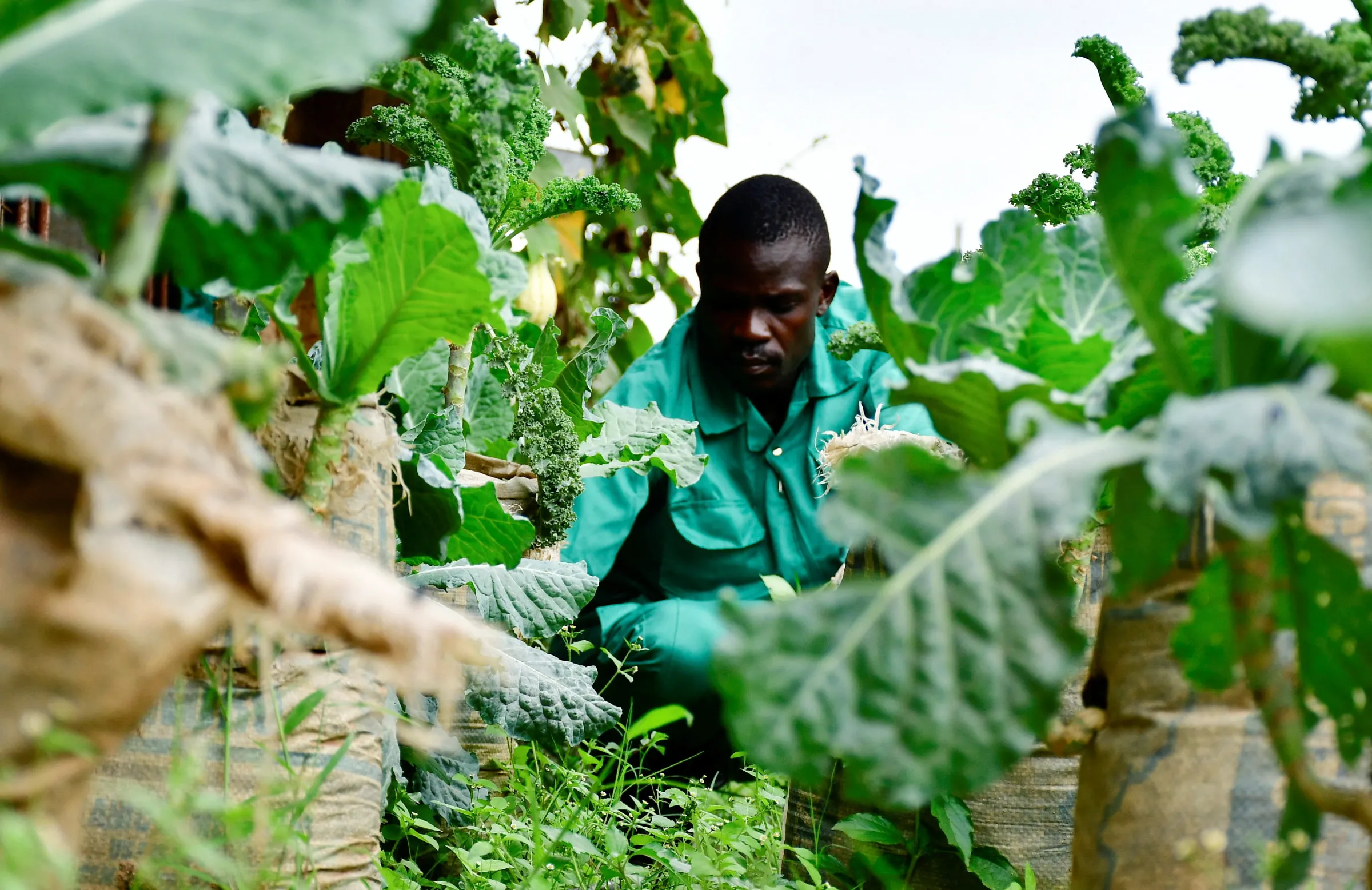
A farm manager attends to his crops at his urban farm in Kamwokya suburb of Kampala, Uganda, August 11, 2025. REUTERS/Abubaker Lubowa
What鈥檚 the context?
As experts discuss food security, here are a few clever fixes that are already feeding people and fighting climate change.
JOHANNESBURG/LAGOS - Be it AI pest detectors in Kenya or Nigerian soil-free farming, climate change is pushing farmers to innovate and show the sort of can-do spirit that experts say is vital if Africa is to overcome its twin scourge of high heat and hunger.
The experts - drawn from government, farming and the lab - are meeting in Senegal to brainstorm new ways to deal with old threats as farmers across whole swathes of Africa face , conflict, a debt crisis and ever-worsening climate shocks.
The Africa Food Systems Forum, underway in Dakar this week, says agricultural productivity on the continent needs to grow 70% by 2050 to feed a population that is projected to grow by 950 million in the same timeframe.
Here are five ways the continent is already pursuing home-grown solutions to food insecurity:
Digital innovations and AI
As internet connectivity expands, so too do digital and AI-powered inventions to boost farming, from digital marketplaces to satellite monitoring for early drought and flood warnings.
In Kenya, for example, computer programmer Esther Kimani developed the Early Crop Pest and Disease Detection Device, a solar-powered tool that uses AI and machine-taught cameras to detect and alert farmers to threats and then offer solutions.
The device can by up to 40%.
Solar power
Abundant sun makes Africa ideal for solar-powered devices, particularly as 43% of people to traditional energy grids, says the International Energy Agency (IEA).
From solar-powered irrigation pumps to fish and crop dryers in Tanzania, farmers and fishermen are making use of the resource to of crops and produce.
Tanzania's MAVUNOLAB uses the sun to power a dryer to speed up the drying process of fish, fruit and vegetables, helping store produce and better weather floods, droughts and heatwaves.
An August study by energy think tank Ember said imports of solar panels from China to Africa in the last 12 months, suggesting a solar pick-up is happening at scale.
Adapting to land shortages and city farming
In Nigeria, a country grappling with the challenge of limited land to feed a rapidly growing population of nearly 220 million, biochemist-turned-engineer Samson Ogbole is using to combat crop losses caused by recurrent floods.
At his Soilless Food Labs, Ogbole uses hydroponics - growing plants with their roots in nutrient-rich water - and aeroponics, which suspends plants in air, combined with AI-driven irrigation systems, to grow vegetables and crops.
This also reduces their vulnerability to floods and drought and allows farmers to plant seasonal crops year-round.
Ogbole has trained thousands of young Nigerians in , and experts say the practice could help city dwellers with little land boost the nation's overall output.
Climate resilient crops
The African Development Bank, AfDB, has stepped in to help countries farm climate-resilient grains and reduce food imports.
About 40% of Africa's wheat imports come from Russia and Ukraine; prices and supplies have both been hit by war.
Through its Technologies for African Agricultural Transformation (TAAT) programme, the AfDB has supported thousands of small-scale farmers from in planting heat-tolerant wheat seeds.
Under the initiative, Ethiopia increased its heat-tolerant wheat production from in 2018 to 2.2 million hectares by 2023.
TAAT transformed the Horn of Africa nation from a wheat importer to a to neighbouring countries such as Djibouti and Kenya, according to the bank.
Regenerative Farming
Regenerative farming is a sustainable farming method that , produces nutrient-rich food and captures carbon in soil and plants.
The Africa Regenerative Agriculture Study Group, a research body, says its methods could deliver annual savings to farmers of up to $17 billion by 2040.
Regenerative farming includes the use of cover crops or plants placed between main crops to protect soil health, an end to tilling and the use of fewer chemicals.
Big agribusiness and smallholders who use the methods are seeing their yields rise 68% to 300%, the study group found.
(Reporting by Kim Harrisberg; Editing by Lyndsay Griffiths.)
Context is powered by the 黑料天堂 Newsroom.
Our Standards:
Tags
- Adaptation
- Agriculture and farming



Featured

Go Deeper
The Backstory
 These links open on


Latest on Context


- 1
- 2
- 3
- 4
- 5
- 6