

India's $4-billon bet to secure critical minerals

Explainer
Explainer
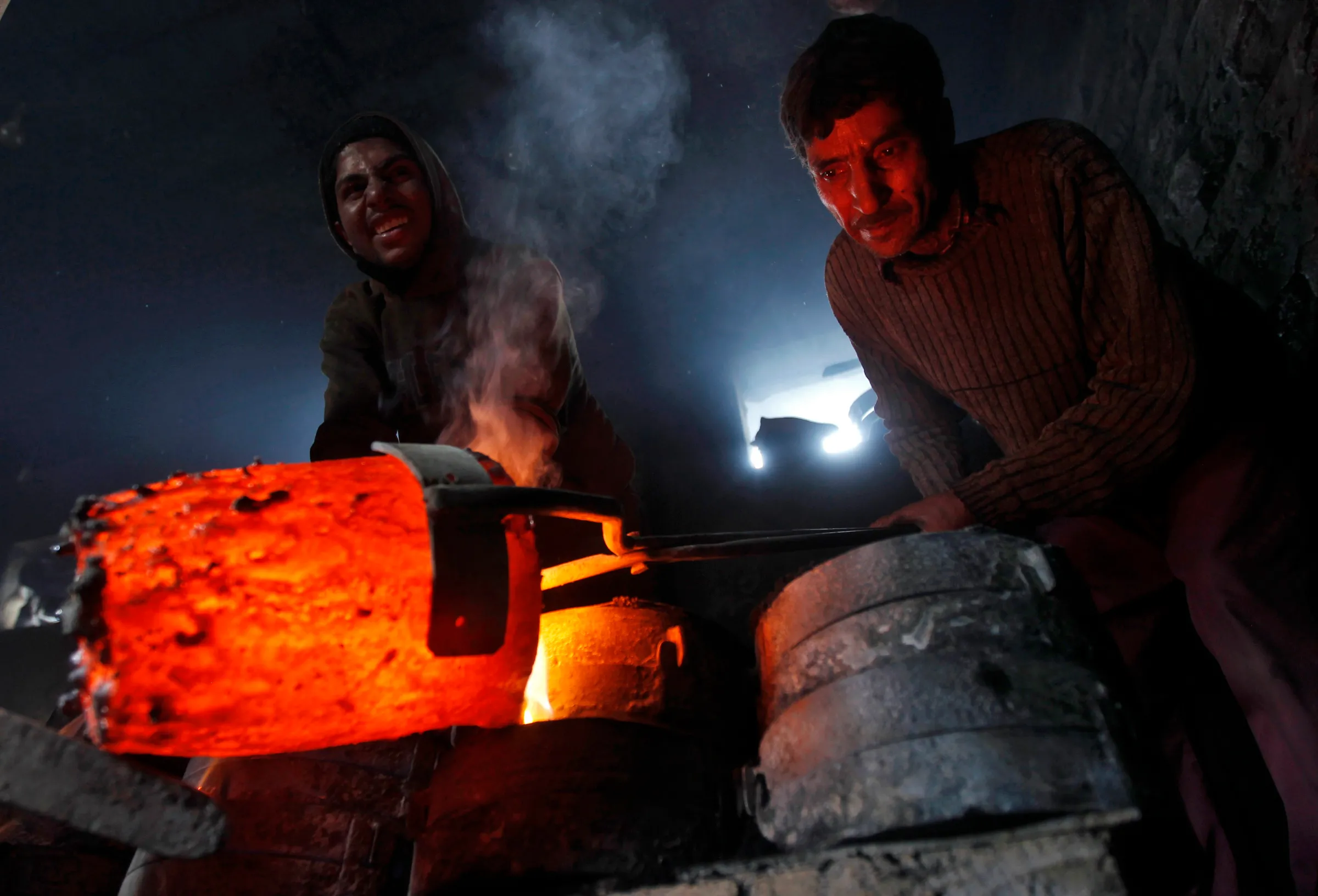
Workers pour melted copper in a mould to make utensils and accessories inside a workshop in Srinagar March 27, 2014. REUTERS/Danish Ismail
What鈥檚 the context?
India launched a $4 billion initiative to secure critical minerals amid a global race pushed by the clean energy transition.
NEW DELHI - As the world rushes to secure minerals critical for rapidly-expanding clean energy technologies, India is joining the fray to try to meet its ambitious green energy goals.
India said in January the government and state mining companies would spend 343 billion Indian rupee ($3.94 billion) to , recycling and imports of critical minerals in a bid to secure enough for its energy transition, in an initiative coined the "National Critical Mineral Mission."
While India produces some of the copper and graphite it uses at home, it fully imports several critical minerals used in green technologies including lithium, cobalt, and nickel.
The government has also mapped out new reserves for critical minerals, but there tends to be a lengthy time-lag between the discovery of new reserves and when mining can start.
India's push is part of a global race for minerals needed for renewable technologies, which is likely to ramp up this year, with demand for 'net zero' minerals set to almost triple by 2030, according to the International Energy Agency.
Here is what you know about India's critical minerals ambition:
Why are critical minerals important for India?
India aims to achieve net-zero greenhouse gas emissions by 2070. To meet this goal, demand for copper and nickel is , said the Centre for Social and Economic Progress, an Indian think tank. It expects demand for copper to grow nearly 6-fold and for nickel 11-fold by 2047. Copper and nickel are widely used in green energy storage technologies, solar panels and electronics among others.
India also aims to make by 2030 -- an ambitious goal given that electric vehicles only represented 1% of total vehicle sales in India as of November 2023, according to government data.
How reliant is India on the import of critical minerals?
While India produces some of the copper and graphite it uses locally, it remains highly dependent on imports for several critical minerals.
India of the lithium, cobalt and nickel it used in 2020, as well as 60% of the graphite it utilised that year, according to the latest available data published by the Ministry of Mines in 2023.
India remains "largely dependent" on imports of critical minerals such as cobalt, copper, graphite, lithium and nickel which play a "central role in the energy transition and are found in few countries," said the Institute for Energy Economics and Financial Analysis (IEEFA), a think tank, in a 2024 report.
"With ambitious climate goals in place, India's demand for critical minerals is in the coming years," it said.
China, the world's top processor of critical minerals, was the biggest exporter of critical minerals to India in 2024, according to local media.
What is India doing to ensure supply of critical minerals?
Under the "National Critical Mineral Mission" initiative launched in January, the government will provide financial incentives to firms aimed at boosting mining, processing, recycling and imports.
In 2023, the government also simplified laws to boost critical mineral exploration, for example by allowing private firms to participate in the mining and exploration of critical minerals. Previously, only state companies could do that in the country.
India is also mapping out its own reserves of critical minerals and has already identified of copper and 210 million tonnes of graphite to be explored, the IEEFA report showed.
India put 48 blocks of mineral reserves up for auction last year. The mining minister said half of these were successful, according to local media.
The IEEFA report said there were also due to unclear data, inadequate capacity from Indian firms and limited technology, among other reasons.
India's recycling ambition
In addition to boosting domestic production, India has put recycling at the centre of its strategy to reduce import reliance. But given its ambitious targets, its nascent recycling industry may struggle to keep up.
India has said it wants to ensure that 20% of all new batteries are made from recycled materials by 2030 and will aim to recover 90% of all battery materials from EVs by 2027.
The World Resources Institute, a global research centre, said India would have to increase its lithium battery recycling capacity to keep up with the battery demand likely to be generated by its ambitious 2030 electric vehicle goal.
($1 = 87.1530 Indian rupees)
(Reporting by Bhasker Tripathi; Editing by Jack Graham and Ana Nicolaci da Costa)
Context is powered by the 黑料天堂 Newsroom.
Our Standards:
Tags
- Clean power
- Adaptation
- Net-zero


Featured
Go Deeper
The Backstory
 These links open on

Latest on Context


- 1
- 2
- 3
- 4
- 5
- 6