Context is powered by the 黑料天堂 Newsroom.
Our Standards:

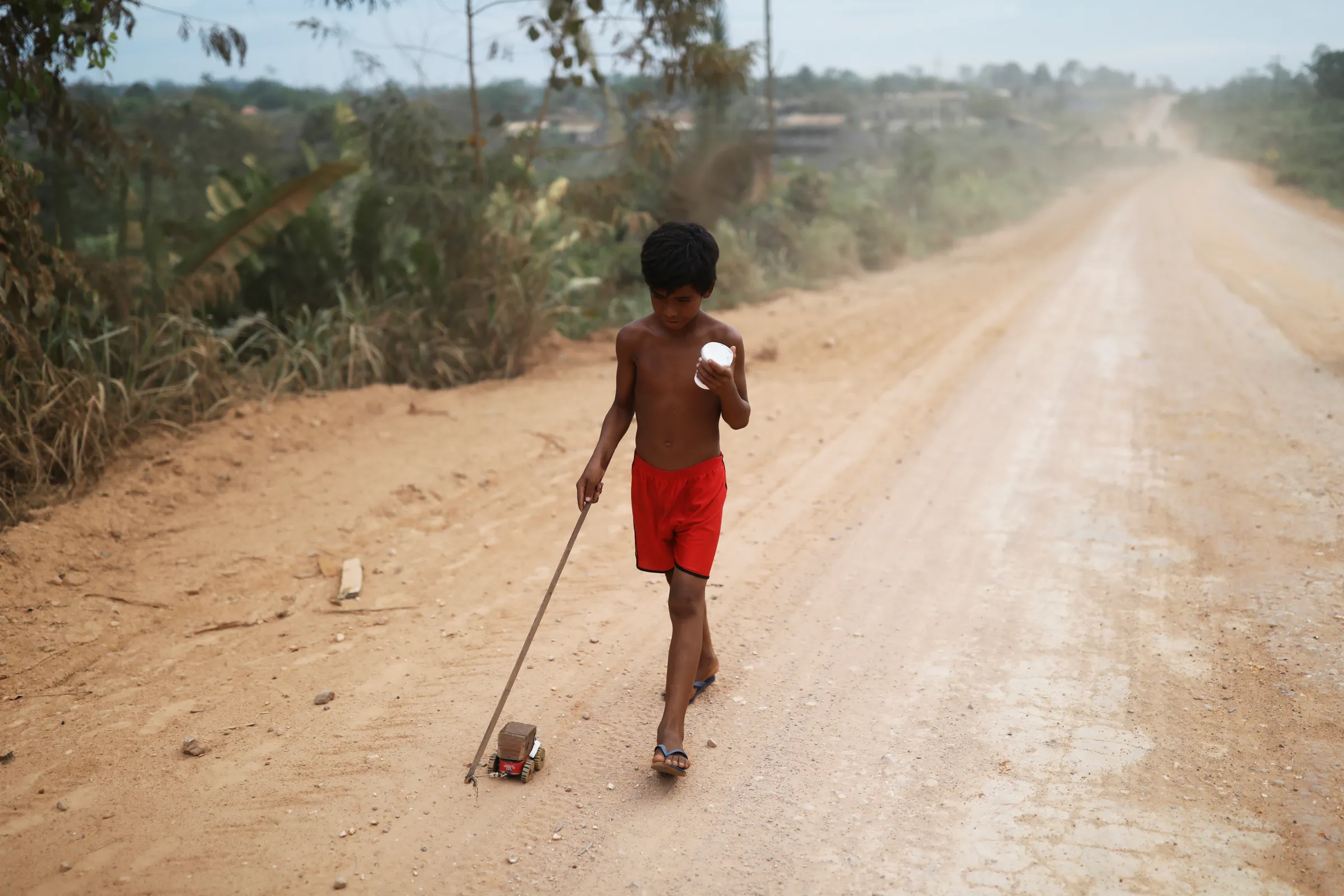
A boy plays with a wooden toy tractor on Trans-Amazonian Highway near the city of Altamira, Para state, Brazil, August 27, 2019. REUTERS/Nacho Doce
For decades, infrastructure projects in Brazil's Amazon rainforest have fuelled deforestation, and more building is in the works.
RIO DE JANEIRO - Ahead of the COP30 climate summit in the Amazon city of Belém, Brazil is pushing ahead with road, railway, mining and oil drilling projects that risk accelerating the destruction of the vast rainforest, environmentalists warn.
In August, President Luiz Inácio Lula da Silva a bill that creates a fast-track special licensing process for projects deemed "strategic," a change hailed by agribusinesses and mining lobbies.
The new law has been criticized by Brazil's Climate Observatory, which said it is a form of "licensing under political pressure" and could unlock large-scale road, railway and mining projects.
Environmentalists fear this will drive further deforestation to make way for cattle pastures and grain farms, which already make Brazil the world's , according to data from NGO World Resources Institute.
Large-scale deforestation gained pace in the Amazon rainforest from the 1960s onwards, when a military dictatorship seized power and began to push infrastructure, especially roads and mining projects, towards forests and savannahs in Brazil's interior.
Once highways are cut through the Amazon, legal and illegal sideroads expand deeper into the forest, exposing it further to tree clearing and fires that lay the ground bare year by year until only fragments of the wilderness are left.
According to 2014 research published in the Biological Conservation Journal, in Brazil's Amazon, where most tree cover loss takes place, occurred within 5.5 km (3.4 miles) of a road or 1 km (0.6 mile) of a navigable river.
In 1970, a government contractor celebrated the initial construction of the 885-km (560-mile) BR-319 road by boasting that "to unite Brazilians, we have ripped the green hell."
Now, Brazil's federal government is pursuing environmental licences to repair the middle section of that same road, which connects Manaus, capital of the state of Amazonas, to Porto Velho, capital of Rondônia.
Environmentalists say the initial road repair work is already fuelling a new land rush, pushing the deforestation frontier further north into one of the best preserved parts of the Amazon where Indigenous groups live in self-isolation.
Brazil's government is also pursuing environmental licences to build railways of unprecedented size across the Amazon, mainly to transport grain such as corn and also soybeans to Amazon waterways that flow into the Atlantic Ocean.
From there, grains can be shipped for exports - a cheaper alternative than using Brazil's saturated southern ports.
One of the most contentious railway projects is the Ferrogrão, a railway 933 km (580 miles) long that international grain traders to carry grains from Brazil's Midwest through the Amazon.
According to a 2020 analysis by the non-profit Climate Policy Initiative, the project would drive losses of more than an (772 square miles) of forest.
Additionally, in July, Brazil and China signed a memorandum to initiate joint studies to build yet route to reach the Pacific through the Amazon.
Environmentalists fear that a weakened licensing process could help push the Amazon to a tipping point from which it would dry out and mostly die back into a degraded savannah.
Climate change and decades of rapid deforestation have already made the forest more vulnerable, scientists warn.
Severe drought has become more common in the last two decades, such as last year, when forest areas in Brazil's Amazon burned twice the previous record, according to mapping consortium MapBiomas.
The massive Ferrogrão railway has faced legal battles and licensing hurdles for years due to its environmental impact on a national park and Indigenous groups.
However, Brazil's government said last month it expects to initiate the bidding process to build it in early 2026.
(Reporting by Andre Cabette Fabio; Editing by Ellen Wulfhorst and Anastasia Moloney.)
Context is powered by the 黑料天堂 Newsroom.
Our Standards:
 These links open on